

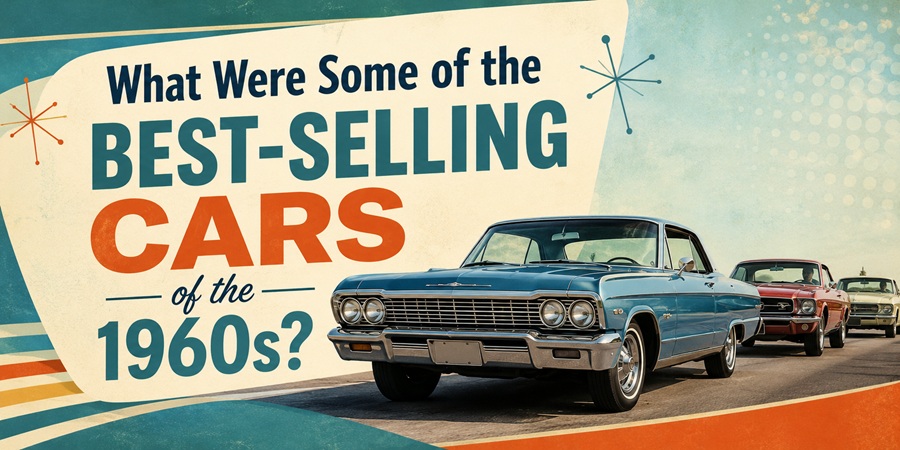
The 1960s were a turning point for the American and global auto industry. Muscle cars were being born, the economy was booming, and buyers had more options than ever before. But beneath all the horsepower headlines, a handful of practical, affordable, and well-built cars were quietly racking up massive sales numbers. These were the vehicles that filled driveways across the country — and some of them shaped the auto industry for decades to come.
1. Ford Falcon (1960–1963)
Before the Mustang stole the spotlight, the Ford Falcon was doing the heavy lifting. Introduced in 1960 as Ford’s answer to rising import competition, the Falcon was compact, fuel-efficient, and priced right. In its debut year alone, Ford sold over 435,000 units — a record for a first-year model at the time.
The Falcon was simple by design. No frills, no excessive chrome, just a car that got people where they needed to go without breaking the bank. It also laid the mechanical groundwork for the Mustang, which launched in 1964 on a modified Falcon platform.
2. Chevrolet Impala (1960s)
If one car defined the 1960s in America, it was the Chevrolet Impala. Full-sized, stylish, and available in a wide range of trim levels, the Impala appealed to families, young buyers, and everyone in between. In 1965, Chevrolet sold over 1 million Impalas — making it the best-selling car in the United States that year.
The Impala offered buyers a genuine choice: you could get a base six-cylinder for daily commuting or step up to a 396 V8 for serious performance. That flexibility kept it at the top of the sales charts for most of the decade. Even today, the ’65 Impala remains one of the most recognized American cars ever built.
3. Ford Mustang (1964½–1969)
No list of 1960s bestsellers is complete without the Mustang. Launched in April 1964 as a 1964½ model, Ford moved over 418,000 units in its first year — a figure that shocked even Ford’s own executives. By the end of 1966, cumulative Mustang sales had crossed the 1 million mark faster than any other car in history at that point.
The Mustang created the “pony car” segment almost overnight and forced every other manufacturer to respond. It hit the sweet spot between affordability and excitement, starting at just $2,368. Buyers could then customize it into something completely their own through Ford’s long options list. That formula worked then, and the Mustang is still in production today because of it.
4. Volkswagen Beetle (1960s)
While American automakers were chasing size and horsepower, Volkswagen was selling simplicity. The Beetle — originally engineered in the 1930s — found a massive audience in 1960s America among budget-conscious buyers and the growing counterculture movement.
By the mid-1960s, VW was importing over 400,000 Beetles per year into the United States. The car’s reliability, low running costs, and honest advertising (DDB’s “Think Small” campaign is still studied in marketing classrooms) made it a genuine phenomenon. The Beetle proved that a small, foreign car could compete head-to-head with Detroit.
5. Pontiac GTO (1964–1969)
The GTO didn’t sell in Impala numbers, but its cultural impact made it impossible to leave off this list. When Pontiac stuffed a 389 cubic-inch V8 into the mid-size Tempest and called it the GTO in 1964, the muscle car era officially began. Pontiac projected sales of 5,000 units; they sold 32,450 in the first year.
By 1966, annual GTO sales had climbed to over 96,000. It gave an entire generation of buyers something they didn’t know they needed: a factory-built street racer at a reasonable price. Every muscle car that followed — the Chevelle SS, the Dodge Charger, the Plymouth Road Runner — owes its existence to what the GTO proved was possible.
6. Chevrolet Corvair (1960–1969)
Before Ralph Nader’s Unsafe at Any Speed (1965) damaged its reputation, the Corvair was a genuine sales success. Its rear-engine, air-cooled layout was unlike anything else in the American market, and buyers responded with curiosity and enthusiasm. In 1961, Corvair sales peaked at around 329,000 units.
The Corvair deserves credit for pushing American engineering in a different direction during the early part of the decade, even if its story ended in controversy.
What Made These Cars Sell?
Looking across this list, a few patterns stand out:
- Price accessibility — The top sellers were attainable for working families, not just wealthy buyers.
- Timing — Each model launched at a moment when the market was ready for exactly what it offered.
- Flexibility — Multiple trims, engines, and body styles meant one model could serve many different buyers.
The 1960s automobile market was competitive, fast-moving, and driven by genuine innovation. The cars that sold best weren’t just popular — they changed what buyers expected from the industry going forward.
For deeper historical sales data and model-year production figures, the Automotive History Preservation Society maintains archives that document these numbers in detail.
The legacy of 1960s bestsellers is still visible today — in modern pony cars, the ongoing muscle car market, and the continued global presence of the Volkswagen Beetle’s spiritual successors.